About the Academy
An academy built around the educator.
A single well prepared mathematics teacher will reach thousands of students across a career. The Math Olympiad Trainer Academy is built on that conviction, and on the belief that mathematical talent across the MENA region is best nurtured by investing in those who teach.
The Math Olympiad Trainer Academy was founded as a comprehensive professional development program for secondary school mathematics teachers across the Middle East and North Africa. Its development was funded by SITE when it was part of the NYU Abu Dhabi Research Institute, and undertaken in academic partnership with MIMS, the Mediterranean Institute for the Mathematical Sciences. The Academy operates as a "Training the Trainers" program for educators. Its purpose is to deepen mathematical understanding and classroom practice.
Our purpose
The Academy's purpose is straightforward. We equip educators with strategies that foster deep mathematical understanding and nurture talent. Through problem solving and reasoning, teachers help students engage with the beauty of mathematics.
The program develops the working repertoire of teachers across the region. It brings advanced olympiad mathematics into secondary school classrooms through sustained professional study and teaching practice.
How we work
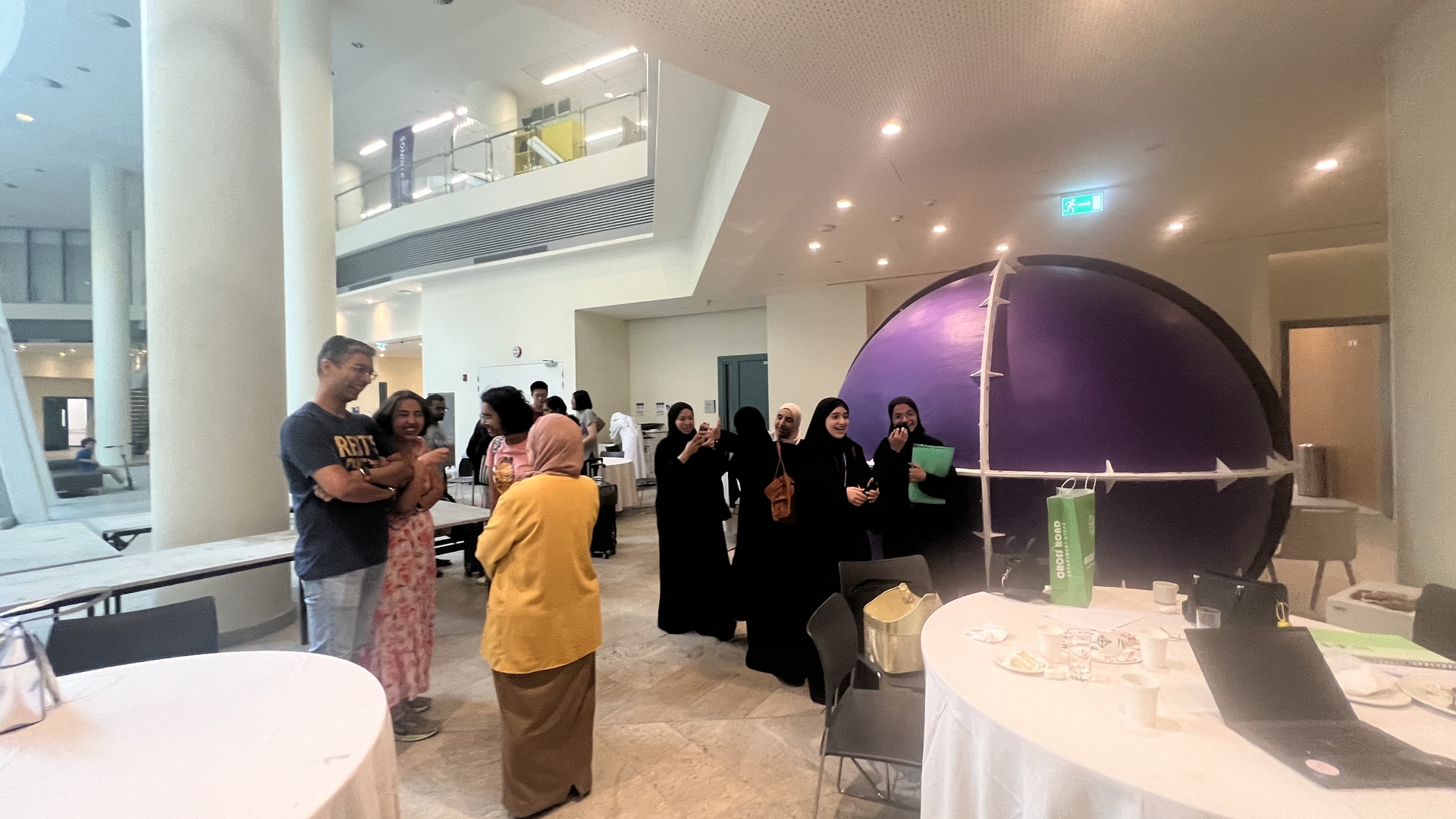
Each academic year is organised into cycles. A cycle covers one or two related areas under a guest coach. Two to four live online sessions usually take place on alternate weekends. A participant presentation closes the cycle. Year One concluded with a weeklong onsite intensive at NYU Abu Dhabi in June 2025. Each live session begins with a theorem and worked example before moving into collaborative problem solving.
Every live session is paired with a fully written set of LaTeX notes prepared by the Academy's academic team. The written record matters: it is what teachers carry back to their classrooms, and it is what accumulates, year on year, into a curriculum.
The mathematical arc is theorem, example, method. The pedagogical arc is to begin with familiar small cycles, and then reveal that those cycles are governed by a general structure.
Who participates
The Academy's participants are secondary school mathematics teachers from across the MENA region and beyond. The community includes teachers from Tunisia, Morocco, Algeria, Mauritania, Egypt, Yemen, Qatar, and the United Arab Emirates. Each teacher brings a distinct curriculum and national olympiad tradition to a shared commitment to stronger mathematics teaching.
The partnership
The Academy is built through two clearly defined roles. SITE, the Stability, Instability and Turbulence Center, which was part of the NYU Abu Dhabi Research Institute and directed by Dr. Nader Masmoudi, provided funding and program support and supported the Year One onsite summer intensive. MIMS, the Mediterranean Institute for the Mathematical Sciences, is the Academy's academic partner and contributes regional reach and strategic liaison through Dr. Sadok Kallel. Individual invited coaches may hold affiliations with other institutions, including the Mathematical Institute SANU. SITE and MIMS hold the Academy's defined institutional roles.
Heritage
Every proof MOTA teachers help their students write echoes a habit of mind that's centuries old. Long before “olympiad mathematics” was a phrase, mathematicians writing in Arabic between the ninth and twelfth centuries were doing something recognisably the same: turning hard, specific problems into general methods, and trusting a chain of logic over a guess.
Take Al-Khwārizmī, working in Baghdad in the early 800s. His treatise on al-jabr and al-muqābala, completion and balancing, organised every quadratic into one of six standard shapes. It handled each with both an algebraic method and a geometric proof, often literally dissecting a square to show why the algebra worked. That's the same move an olympiad student makes when they reduce a complex equation to a known case and justify the reduction rigorously.
A generation later, Thābit ibn Qurra, born around 836 in Ḥarrān, later court astronomer in Baghdad, proved a theorem that generates whole families of amicable numbers from a simple set of conditions on primes. It's pure number theory, built the way olympiad number theory is built: find the structure, state the general rule, prove it holds for every case that satisfies the conditions. Thābit also generalised the Pythagorean theorem to arbitrary triangles. This generalisation reflects the kind of structural question that drives a strong geometry problem.
Al-Karajī came a century after that, also in Baghdad. His Al-Fakhrī and Al-Badī‘ pushed algebra away from geometric figures and toward pure symbolic manipulation of powers of x. He worked out the identity that the sum of the first n cubes equals the square of the sum of the first n numbers, and demonstrated it through a sequence of cases beginning with n = 1. Historians treat this repeated process as an ancestor of mathematical induction. He also extended problems from Diophantus's Arithmetica into more general methods.
Ibn al-Haytham, working between Basra and Cairo, is best known for optics, but his mathematical side turns up in a problem that reads like it belongs on a modern number theory olympiad set: find a number that leaves remainder 1 when divided by 2, 3, 4, 5 or 6, yet divides evenly by 7. His method relied on what we now call Wilson's theorem. Al-Bīrūnī, further east and later in Ghazna and India, brought the same rigour to measurement: he calculated Earth's radius using trigonometry and a mountaintop sighting, and was unusually careful about tracking and reporting his own margins of error.
The clearest throughline to modern training might be Al-Samaw’al al-Maghribī, born in Baghdad around 1130 and later based in Marāgha. His Al-Bāhir fī'l-jabr contains a closed form expression for the sum of the first n squares, the kind of identity every olympiad student eventually proves by induction, along with a genuine olympiad combinatorics problem: recover ten unknown quantities from the 210 equations that give their sums taken six at a time. Al-Samaw’al used the same rough inductive technique Al-Karajī had developed and credited the method to him. This intellectual honesty shaped a tradition of scholars checking, extending, and crediting each other's work across generations and cities from Ḥarrān to Baghdad and Cairo.
These historical problems directly inform the Academy's teaching. Each asks the solver to state a general claim, build the argument step by step, and carry the proof to completion. MOTA continues this tradition of mathematicians writing in Arabic and developing general methods from difficult problems.
Source note Dates, geographic bases and treatise titles for the six scholars above are drawn from the MacTutor History of Mathematics archive (University of St Andrews) and verified against Encyclopædia Britannica biographies for each figure, with Al-Samaw’al’s Al-Bāhir further checked against Roshdi Rashed’s 2021 critical edition (De Gruyter, Scientia Graeco-Arabica). Named priority claims (Hogendijk on the amicable pair 17296 / 18416; Rashed and Woepcke on Al-Karajī’s algebraic calculus) are described with their scholarly hedges intact. The account treats “father of algebra” as a contested framing. Each scholar has a fuller standalone page in the Historical Profiles, with full citation blocks.
In numbers
The Academy at a glance.
Founded 2024
The Academy launched in September 2024 with funding and support from SITE, in academic partnership with MIMS.
2025 to 2026 completed
Four cycles of live sessions and written LaTeX notes, each led by a guest coach and closing with teacher presentations.
8+ countries
Participating teachers from across the MENA region, along with a small group of international observers.
A written curriculum
Every session yields full LaTeX notes and expands an archive that teachers carry back to their classrooms.
Read more, then come and teach with us.
Each cycle accepts a new cohort of teachers. The application opens between cycles and the next round is on its way.